The Development of Art Vs Rise and Fall of Dynasties
Painting during the Six Dynasties Period
During the Half-dozen Dynasties period (220–589 CE), people began to write about art and capeesh painting for its own beauty.
Learning Objectives
Summarize the 6 Principles of painting according to Xie He and draw a timeline of the eras within the Six Dynasties
Key Takeaways
Key Points
- The Six Dynasties period takes its name from the six ruling dynasties of the era: the Eastern Wu (222–280), Jin (265–420), Liu Song (420–479), Southern Qi (479–502), Liang (502–557), and Chen (557–589) Dynasties.
- Individual artists began to rise to attention, such as Gu Kaizhi. Many illustrated Confucian moral themes—such every bit the preferred behavior of a married woman to her husband or of children to their parents—with gracefully drawn figures.
- Xie He—a writer, fine art historian, and critic in 5thursday century China—is nigh famous for outlining six points to consider when judging a painting, taken from the preface to his book, The Record of the Nomenclature of Former Painters.
- Xie He'south six elements include: 1) Spirit Resonance, 2) Bone Method, iii) Correspondence to the Object, four) Suitability to Blazon, 5) Division and Planning, and 6) Transmission by Copying.
Cardinal Terms
- vitality: Energy or vigor.
- Confucian: One who follows the teachings of Confucius.
The Six Dynasties period (220–589 CE) takes its proper name from the half-dozen ruling dynasties of the era: the Eastern Wu Dynasty (222–280), Jin Dynasty (265–420), Liu Song Dynasty (420–479), Southern Qi Dynasty (479–502), Liang Dynasty (502–557), and Chen Dynasty (557–589). During the Six Dynasties flow, people began to write nearly fine art and appreciate painting for its own beauty. Individual artists began to rise to attending, such as Gu Kaizhi.
Many illustrated Confucian moral themes—such as the preferred behavior of a wife to her husband or of children to their parents—with gracefully drawn figures.

Luoshenfu, Gu Kaizhi (344-406 CE): The painting Luoshenfu by artist Gu Kaizhi, painted during the Six Dynasties Period.
The Six Principles
Xie He—a writer, art historian, and critic in 5thursday century People's republic of china—is almost famous for outlining vi points to consider when judging a painting. These were taken from the preface to his book, The Record of the Classification of Quondam Painters, written circa 550 CE. According to him, the 6 elements that define a painting are:
- Spirit Resonance, or vitality , which refers to the flow of energy that encompasses theme, work, and artist. Xie He said that without Spirit Resonance, there was no demand to explore a painting farther.
- Bone Method, or the way of using the brush, which refers not only to texture and brush strokes, but also to the close link between handwriting and personality. In his twenty-four hours, the art of calligraphy was inseparable from that of painting.
- Correspondence to the Object, or the depicting of form , which includes shapes and lines .
- Suitability to Type, or the application of color, which includes layers, value , and tone .
- Division and Planning, or placing and arrangement, which corresponds to composition , space , and depth.
- Transmission by Copying, or the copying of models, which means not only from life but besides from works of antiquity .

Tomb mural: Murals from a tomb of the Six Dynasties menstruum (550-577 CE) in Jiuyuangang, Xinzhou, showing a rural hunting scene on horseback.
Calligraphy during the Six Dynasties Period
The calligraphic tradition of East Asia originated in Communist china and greatly advanced during the 6 Dynasties period.
Learning Objectives
Draw the evolution of Chinese calligraphy from ancient China to the Six Dynasties
Primal Takeaways
Key Points
- Chinese calligraphy is an creative writing form widely practiced and revered in the Sinosphere , which includes China, Japan, Korea, and Vietnam.
- The various styles of calligraphy adhere to general standards. Chinese calligraphy and ink and launder painting are closely related, achieved using similar tools and techniques.
- In aboriginal China, painting and calligraphy were the most highly appreciated arts in court circles. They were washed almost exclusively by amateurs, aristocrats, and scholar-officials who had the leisure to perfect the technique.
- Invented in the 1st century, newspaper gradually replaced silk as the backdrop for calligraphy. Original writings by famous calligraphers have been highly valued throughout People's republic of china's history and are mounted on scrolls and hung on walls like paintings.
- Some of the nearly famous Chinese calligraphers, including Wang Xizhi, lived during the Six Dynasties menses.
- Wang Xizhi'due south well-nigh famous work is the Lanting Xu, the preface to a collection of poems written by a number of poets who gathered at Lan Ting, about the town of Shaoxing in Zhejiang province.
Central Terms
- literati: A person who engages in critical study, thought, and reflection well-nigh the reality of society.
- sinosphere: Areas and countries that have been heavily influenced past Chinese culture.
- soot: Fine black or wearisome brown particles of baggy carbon and tar produced by the incomplete combustion of coal or oil.
- ink and launder painting: An East Asian type of brush painting of Chinese origin that uses the same black ink equally in East Asian calligraphy; also known as literati painting.
Background: Calligraphy and Ancient China
Calligraphy, a visual art related to writing, is the blueprint and execution of lettering with a broad tip castor or other instrument. The calligraphic tradition of Due east Asia originated in China and is widely practiced and revered in the Sinosphere (a designation that ofttimes includes Prc, Nippon, Korea, and Vietnam). The diverse styles of calligraphy in the tradition adhere to a general standards. Chinese calligraphy and ink and launder painting are closely related, as they are accomplished using similar tools and techniques. Chinese painting and calligraphy are distinguished from other cultural arts because they emphasize motion and tend to be charged with dynamic life.
In ancient China, painting and calligraphy were the well-nigh highly appreciated arts in courtroom circles; they were washed most exclusively past amateurs, aristocrats, and scholar-officials who had the leisure to perfect the technique and sensibility necessary for great brushwork. Calligraphy was considered the purest form of painting. The implements included the brush pen fabricated of animal hair and blackness inks made from pine soot and animal gum. Writing and painting were done on silk, gradually replaced subsequently the invention of paper in the 1st century. Original writings by famous calligraphers have been valued throughout China's history; they are mounted on scrolls and hung on walls equally paintings are.
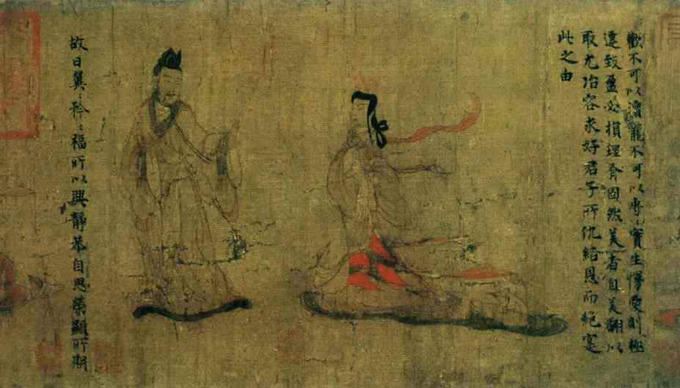
Palace Lady detail from Admonitions of the Instructress to the Palace Ladies: In ancient China, painting and calligraphy were the most highly appreciated arts in court circles; they were done about exclusively past amateurs, aristocrats, and scholar-officials who had the leisure to perfect the technique and sensibility necessary for great brushwork.
Calligraphy during the Six Dynasties
Some of the most famous Chinese calligraphers lived during the Vi Dynasties period. The Six Dynasties refers to the dynasties during the periods of the Eastern Wu Dynasty (222–280), Jin Dynasty (265–420), Liu Vocal Dynasty (420–479), Southern Qi Dynasty (479–502), Liang Dynasty (502–557), and Chen Dynasty (557–589).
Wang Xizhi and the Lanting Xu
One of these famous calligraphers was Wang Xizhi, who lived during the fourth century CE in the middle of the Jin Dynasty. His about famous work is the Lanting Xu, the preface to a collection of poems written by a number of poets who gathered at Lan Ting virtually the town of Shaoxing in Zhejiang province. Wang Xizhi was traditionally referred to equally the Sage of Calligraphy and is considered i of the virtually esteemed Chinese calligraphers of all fourth dimension and a main of all forms, especially the running script. The Emperor Taizong admired his works greatly. In addition to the Wang Xizhi's esteem in China, he has been and remains influential in Japanese calligraphy.
The Lantingji Xu is a famous work of calligraphy by Wang Xizhi composed in the year 353 CE. Written in semi-cursive script, it is among the best-known pieces of calligraphy in Chinese history and is frequently copied. This work began equally the preface to a seminal drove of Chinese nature verse but adult a life of its own. The preface describes an event during that year's Bound Purification Festival in which 42 literati , including Xie An and Sun Chuo, were nowadays at a gathering at the Orchid Pavilion about Shaoxing, Zhejiang, at which they composed poems, played music, and enjoyed wine. The preface consists of 324 Chinese characters in 28 lines . The character zhī (之) appears 20 times, only no two appearances look the same, a feature that constitutes calligraphic excellence. This historic piece of work of literature flows rhythmically and gave ascent to several Chinese idioms .

Primary text of a Tang Dynasty re-create of Wang Xizhi's Lantingji Xu, by Feng Chengsu.: Throughout Chinese history, many copies were made of the Lantingji Xu, which described the beauty of the mural around the Orchid Pavilion and the get-together of Wang Xizhi and his friends. The original is lost; yet, some believe it was buried in the mausoleum of Emperor Taizong of Tang. This Tang copy made betwixt 627-650 CE is considered the best of the copies that has survived.
Compages during the Half dozen Dynasties Period
The 6 Dynasties (220-589 CE) in Chinese history was a fourth dimension of groovy advancements in compages.
Learning Objectives
Characterize the compages and fine art of the Six Dynasties
Primal Takeaways
Key Points
- The Six Dynasties generally includes the periods of the Three Kingdoms (220–280 CE), the Jin Dynasty (265–420 CE), and the Southern and Northern Dynasties (420–589 CE).
- By the 6th century, Buddhism had spread with tremendous momentum throughout China and dramatically influenced Chinese architecture.
- Although multiple-story towers such equally guard towers and residential apartments existed in previous periods, it was during this time that the Chinese transformed the rounded earthen mound of the stupa into the towering pagoda to house the sacred buried relics of Buddha at its cadre.
- The Songyue Pagoda, built in 523, is the oldest extant pagoda in China; its unique many-sided shape may stand for an early attempt to merge the Chinese architecture of straight edges with the circular manner of Buddhism from the Indian subcontinent.
- Although by and large simply ruins of brick and rammed globe walls and towers from the Six Dynasties take survived, data on ancient Chinese architecture can exist discerned from realistic clay models of buildings created equally funerary items.
- The Jin Dynasty was especially known for miniature models of buildings used to decorate the tops of "soul vases" and for its celadon porcelain wares.
Key Terms
- celadon: Ceramic ware with a stake green coat.
- ensemble: A grouping of split up things that contribute to a coordinated whole.
Groundwork: The Six Dynasties
The 6 Dynasties is a collective term for 6 Chinese dynasties during the periods of the Three Kingdoms (220–280 CE; also known every bit the Eastern Wu or the Cao Wei), the Jin Dynasty (265–420 CE), and the Southern and Northern Dynasties (420–589 CE), which included the Liu Song, Southern Qi, Liang, and Chen Dynasties. During this time, the Chinese people made great advancements in compages.
Architecture in the Six Dynasties
By the 6th century, Buddhism had spread with tremendous momentum throughout China, and Chinese culture was adjusting and adapting its traditions to include Buddhism worship. This also had a profound influence on architecture. Although multiple-story towers such every bit baby-sit towers and residential apartments existed in previous periods, the singled-out Chinese pagoda tower (used for storing Buddhist scriptures) evolved during the Half dozen Dynasties menstruum from the stupa, which came from Buddhist traditions of protecting sutras in ancient India. The Chinese transformed the rounded earthen mound of the stupa into the towering pagoda to house the sacred buried relics of Buddha at its core.
The Songyue Pagoda, built in 523, is the oldest extant pagoda in Cathay, indelible primarily because it was constructed from brick instead of wood. The unique many-sided shape of the Songyue Pagoda may represent an early on attempt to merge the Chinese architecture of straight edges with the circular style of Buddhism from the Indian subcontinent. The perimeter of the pagoda decreases every bit information technology rises, equally seen in Indian and Cardinal Asian Buddhist cavern temple pillars and the later round pagodas in China.

Songyue Pagoda: A circular-based stone-constructed Buddhist pagoda built in 523 CE during the Southern and Northern Dynasties flow of the Vi Dynasties. It is the oldest existent rock Chinese pagoda. Earlier wooden Chinese pagodas have not survived.
Funerary Models
Tombs of members of the ruling Xiao family unit, with sculptural ensembles in diverse states of preservation , are located nearly Nanjing. The all-time surviving example of a monumental statuary from the Liang Dynasty is the ensemble of the Tomb of Xiao Xiu (475–518 CE), a brother of Emperor Wu, located in Qixia Commune east of Nanjing.
Although mostly only ruins of brick and rammed earth walls and towers from the Six Dynasties take survived, information on aboriginal Chinese compages (specially wooden architecture) can be discerned from realistic clay models of buildings created as funerary items. These depicted miniature versions of Vi Dynasties architecture. Throughout the Six Dynasties, miniature models of buildings or unabridged architectural ensembles were made to decorate the tops of "soul vases" (hunping) institute in many tombs of that menstruum. In add-on to illustrating compages, jar designs often incorporated animal and Buddhist figures.

Eastern Wu artwork depicting architecture: A dark-green-glaze ceramic jar from the Three Kingdoms (or Eastern Wu) period with human figures, birds, and architecture, on display in the Nanjing Museum.

Jar of the Western Jin: Jar designs of the Jin Dynasty often incorporated architectural designs also equally fauna and Buddhist figures.
Advances in Technology
Engineering advanced significantly during the relatively brusk Three Kingdoms (220-280 CE) period, including in the realm of architecture. Shu chancellor Zhuge Liang invented the wooden ox, an early on form of the wheelbarrow, and improved on the repeating crossbow. Wei mechanical engineer Ma Jun is considered the equal of his predecessor Zhang Heng. He invented a hydraulic-powered mechanical puppet theater for Emperor Ming of Wei; square-pallet chain pumps for irrigation of gardens in Luoyang; and the ingenious design of the South Pointing Chariot, a non-magnetic directional compass operated by differential gears.
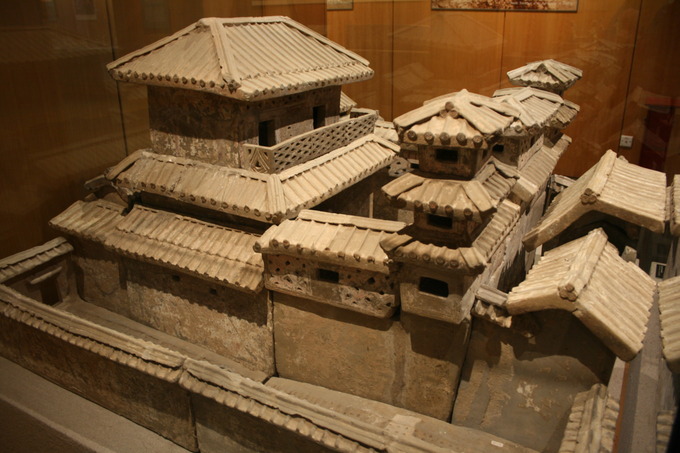
Pottery Palace: Though from the Han Dynasty (c. 2nd century BCE – 2nd century CE), this pottery palace provides a good instance of pottery created for elite burying that illustrates the architecture of the time.
Source: https://courses.lumenlearning.com/boundless-arthistory/chapter/the-six-dynasties-period/
0 Response to "The Development of Art Vs Rise and Fall of Dynasties"
Post a Comment