As a Director of a Small Art Gallery One of Dredericas Major Conerns
| Musée des beaux-arts de l'Ontario | |
 | |
 Dundas Street façade of the AGO in 2009 | |
| Location of the gallery in Toronto | |
| Established | 1900 (1900) |
|---|---|
| Location | 317 Dundas Street West Toronto, Ontario M5T 1G4 |
| Coordinates | 43°39′xiv″North 79°23′34″W / 43.65389°Northward 79.39278°W / 43.65389; -79.39278 Coordinates: 43°39′14″Due north 79°23′34″W / 43.65389°N 79.39278°Westward / 43.65389; -79.39278 |
| Type | Fine art museum |
| Visitors | 974,736 (2018) 3rd most visited nationally 80th about-visited globally[1] |
| Director | Stephan Jost[2] |
| President | Robert J. Harding[three] |
| Curator | Julian Cox (Primary Curator) |
| Public transit access |
|
| Website | ago |


 St. Patrick
The Art Gallery of Ontario (Ago; French: Musée des beaux-arts de l'Ontario) is an fine art museum in Toronto, Ontario, Canada. The museum is located in the Grange Park neighbourhood of downtown Toronto, on Dundas Street W between McCaul and Beverley streets only east of Chinatown. The museum's building circuitous takes upwards 45,000 square metres (480,000 sq ft) of physical space, making it one of the largest art museums in N America and the 2d-largest art museum in Toronto after the Majestic Ontario Museum. In addition to exhibition spaces, the museum also houses an artist-in-residence office and studio, dining facilities, event spaces, souvenir store, library and archives, theatre and lecture hall, enquiry centre, and a workshop.
Established in 1900 as the Art Museum of Toronto, and formally incorporated in 1903, it was renamed the Art Gallery of Toronto in 1919, before information technology adopted its present proper name, the Art Gallery of Ontario, in 1966. The museum acquired the Grange in 1911 and afterwards undertook several expansions to the north and west of the structure. The starting time series of expansions occurred in 1918, 1924, and 1935, designed by Darling and Pearson. Since 1974, the gallery has undergone four major expansions and renovations. These expansions occurred in 1974 and 1977 by John C. Parkin, and 1993 past Barton Myers and KPMB Architects. From 2004 to 2008, the museum underwent another expansion by Frank Gehry. The museum complex saw further renovations in the 2010s by KPMB and Hariri Pontarini Architects.
The museum's permanent collection includes over 120,000 works spanning the beginning century to the present twenty-four hours.[iv] The museum collection includes a number works from Canadian, First Nations, Inuit, African, European, and Oceanic artists. In addition to exhibits for its collection, the museum has organized and hosted a number of travelling art exhibitions.
History [edit]

A south view of the first expansion building in 1922
The museum was founded in 1900 as the Art Museum of Toronto past a group of individual citizens and members of the Toronto Society of Arts.[5] [six] The institution'southward founders included George A. Cox, Lady Eaton, Sir Joseph W. Flavelle, J. W. L. Forster, E. F. B. Johnston, Sir William Mackenzie, Hart A. Massey, Prof. James Mavor, F. Nicholls, Sir Edmund Osler, Sir Henry M. Pellatt, George Agnew Reid, Byron Edmund Walker, Mrs. H. D. Warren, E.R. Wood, and Frank P. Wood.[seven]
The museum's incorporation was confirmed by the Government of Ontario 3 years after by legislation,[6] in An Act respecting the Art Museum of Toronto in 1903. The legislation provided the museum with expropriation powers in order to acquire land for the museum.[8] Before the museum moved into a permanent location, information technology held exhibitions in rented spaces belonging to the Toronto Public Library virtually the intersection of Brunswick Artery and College Street.[nine]
The museum acquired the holding it presently occupies shortly later the death of Harriet Boulton Smith in 1909, when she bequeathed her historic 1817 Georgian estate, The Grange, to the gallery upon her decease.[x] [11] Withal, exhibitions continued to exist held in the rented spaces at the Toronto Public Library branch until June 1913, when The Grange was formally opened equally the fine art museum.[9] In 1911, buying of The Grange, and the surrounding property was formally transferred to the museum.[12] Shortly afterwards, the museum signed an agreement with the municipal government of Toronto to maintain the grounds s of The Grange equally a municipal park.[12]

View of Walker Courtroom in 1929, several years after information technology opened.
In 1916, the museum drafted plans to construct a small portion of a new gallery edifice designed by Darling and Pearson in the Beaux-Arts style.[9] Excavation of the new facility began in 1916. The first galleries adjacent to The Grange were opened in 1918. In the side by side year, the museum was renamed the Art Gallery of Toronto, in an effort to avoid confusion with the Royal Ontario Museum.[thirteen] In 1920, the museum also allowed the Ontario College of Fine art to construct a building on the grounds. The museum was expanded again in 1924, with the opening of the museum'southward sculpture courtroom, its two adjacent galleries, and its main entrance on Dundas Street.[13] The museum was expanded again in 1935 with the structure of two boosted galleries.[13] Portions of the 1935 expansions were financed by Eaton'south.[12]
In 1965, the museum saw its drove of European and Canadian artworks expand, with the conquering of 340 works from the Canadian National Exhibition.[14] During the mid-1960s, the director of the museum, William J. Withrow, pushed to accept the museum designated as a provincial museum, in an effort to proceeds farther provincial funding for the establishment.[15] In 1966, the museum inverse its proper name to the Art Gallery of Ontario, in order to reflect its new mandate to serve as the provincial fine art museum.[16]

Exterior façade of the art museum in 1960
In the 1970s, the museum embarked on another expansion of its gallery space,[xiii] with its first phase completed with the opening of the Henry Moore Sculpture Centre on October 26, 1974. Although the museum planned on expanding its Canadian exhibits in its second phase of expansions, the creation of a heart dedicated to a not-Canadian artists drew criticism from Canadian Artists' Representation, and threatened to protestation the opening of the centre.[17]
The museum was expanded over again in 1993, which saw the 9,290.3 square metres (100,000 sq ft) of new infinite and 17,651.6 foursquare metres (190,000 sq ft) of renovations—usable space, increasing the preexisting floorspace by 30 per cent. The expansion saw the renovation of 20 galleries and the construction of 30 galleries.[eighteen] In 1978, the museum's staff was unionized nether the Ontario Public Service Employees Union.[15]
During the 1990s, the museum drafted plans that would have seen the development of a pedestrian mall from University Artery to the fine art gallery.[19] However, conflicting developments on adjacent backdrop, lack of support from the City of Toronto government, and the eventual development of another renovation plan by architect Frank Gehry saw the museum'south plans for a pedestrian mall abandoned in the early 2000s.[19]
In 1996, Canadian multi-media artist Jubal Chocolate-brown vandalized Raoul Dufy's Harbor at le Havre in the Art Gallery of Ontario by deliberately vomiting main colours on them.[20]

Construction for the Frank Gehry redesign of the museum complex in February 2008
Under the direction of then-CEO Matthew Teitelbaum, the museum embarked on a CA$254 meg (later on increased to CA$276 million) redevelopment programme by Gehry in 2004, called Transformation Ago. Although Gehry was born in Toronto, the redevelopment of the museum complex would be his first work in Canada. The project initially drew some criticism. As an expansion, rather than a new cosmos, concerns were raised that the structure would non expect similar a Gehry signature edifice,[21] and that the opportunity to build an entirely new gallery, perhaps on Toronto's waterfront, was being squandered. During the course of the redevelopment planning, board member and patron Joey Tanenbaum temporarily resigned his position over concerns nearly donor recognition, design issues surrounding the new building, likewise as the cost of the project. The public rift was subsequently healed.[22]
Kenneth Thomson was a major benefactor of Transformation Ago, donating much of his fine art collection to the gallery (providing large contributions to the European and Canadian collections), in addition to providing CA$50 1000000 towards the renovation, also as a CA$20 million endowment.[23] Thomson died in 2006, ii years before the project was complete.
In 2015, the Canadian Jewish News reported 46 paintings and sculptures in the museum'south possession held "a gap in provenance," with the history of their ownership from the years 1933 and 1945 having disappeared.[24] The museum publishes spoliation research on its public website.[25]
In 2018, the museum formally changed the name of Emily Carr's 1929 The Indian Church painting to Church at Yuquot Village in an effort to remove culturally insensitive language from the title of works in its collection.[26] A notation next to the painting provides the original proper name of the piece and explains Carr's utilize of the term was with keeping in "the linguistic communication of her era".[26] The museum has also reviewed the titles of several other works on a example-by-case basis, as items from the Canadian collection are rotated from its exhibit, or from its storage.[27]
In May 2019, the museum revised its admission model, offer free entry to visitors 25 years of age and nether and a CA$35 pass for all others, which provides admission to the museum for the entire year.[28]
In 2020, the work Still Life with Flowers by Jan van Kessel the Elder, was restituted to the heirs of Dagobert and Martha David, later the museum confirmed that it was stolen fine art.[29] [xxx] [31]
Selected exhibitions since 1994 [edit]

Advertisement for King Tut: The Aureate Male monarch and the Great Pharaohs exhibition hosted at the Fine art Gallery of Ontario in 2009
The Art Gallery of Ontario has hosted and organized a number of temporary and travelling exhibitions in its galleries. A select listing of exhibitions since 1994 include:
- From Cézanne to Matisse: Great French Paintings from The Barnes Foundation (1994)
- The OH!Canada Project (1996)
- The Courtauld Collection (1998)
- Treasures from the Hermitage Museum, Russian federation: Rubens and His Age (2001)
- Voyage into Myth: French Painting from Gauguin to Matisse, from the Hermitage Museum (2002)
- Turner, Whistler, Monet: Impressionist Visions (2004)
- Catherine the Keen: Arts for the Empire – Masterpieces from the Hermitage Museum, Russian federation (2005)
- Emily Carr: New Perspectives on a Canadian Icon (2007)
- Drawing Attention: Selected Works on Newspaper from the Renaissance to Modernism (2009)
- King Tut: The Golden King and the Great Pharaohs (2009)
- Rembrandt/Freud: Etchings from Life (2010)
- Julian Schnabel: Art and Moving picture (2010)
- Maharaja: The Splendour of India's Royal Courts (2010)
- Drama and Desire: Artists and the Theatre (2010)
- At Work: Hesse, Goodwin, Martin (2010)
- The Shape of Anxiety: Henry Moore in the 1930s (2010)
- Blackness Ice: David Blackwood Prints of Newfoundland (2011)
- Abstract Expressionist New York (2011)
- Haute Culture: General Idea (2011)
- Chagall and the Russian Avant-garde: Masterpieces from the Drove of the Centre Georges Pompidou, Paris (2011)
- Jack Chambers: Low-cal, Spirit, Time, Place and Life (2012)
- Iain Baxter&: Works 1958–2011 (2012)
- Picasso: Masterpieces from the Musée Picasso Paris (2012)
- Berenice Abbott: Photographs (2012)
- Frida & Diego: Passion, Politics and Painting (2012)
- Francis Bacon and Henry Moore: Terror and Beauty (2014)
- Vija Celmins: To Gear up the Image in Retentivity (2019)
- Jean-Michel Basquiat: Now's The Fourth dimension (2015)
- J. M. W. Turner: Painting Set Free (2015)
- Outsiders: American Photography and Film, 1950s–1980s (2016)
- The Idea of Due north: The Paintings of Lawren Harris (2016)
- Theaster Gates: How to Build a Firm Museum (2016)
- Small Wonders: Gothic Boxwood Miniatures (2016)
- Mystical Landscapes: Masterpieces from Monet, Van Gogh and More (2016)
- Toronto: Tributes + Tributaries, 1971–1989 (2016)
- Every. Now. So. Reframing Nationhood (2017)
- Rita Letendre: Fire & Low-cal (2017)
- Free Black North (2017)
- Guillermo del Toro: At Dwelling with Monsters (2017)
- Yayoi Kusama: Infinity Mirrors (2018)
- Mitchell/ Riopelle: Nothing in Moderation (2018)
- Tunirrusiangit: Kenojuak Ashevak and Tim Pitsiulak (2018)
- Mickalene Thomas: Femmes Noires (2018)
- Rebecca Belmore: Facing the Monumental (2018)
- Anthropocene (2018)
- Impressionism in the Age of Industry: Monet, Pissarro and more (2019)
- Brian Jungen Friendship Centre (2019)
- Early Rubens (2019)
- Hito Steyerl: This is the time to come (2019)
Architecture [edit]
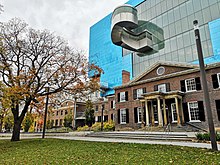
The museum complex includes two buildings, The Grange (right foreground), and the main building expansion to the north and west of it
The holding the museum occupies was acquired in 1911, when The Grange, and the surrounding property south of Dundas Street were bequeathed to the institution by Harriet Boulton Smith. The Grange manor was reopened to serve as the museum'due south edifice in 1913. Since its opening, the museum underwent several expansions to the north, and west of The Grange. Expansions to the museum were opened in 1918, 1924, 1935, 1974, 1977, 1993, and 2008.[ix]
The museum complex takes upward 45,000 square metres (480,000 sq ft) of physical infinite,[9] and is made up of ii buildings, The Grange, and the main building expansion, built to the n, and west of The Grange. After the main building's redevelopment in 2008, the museum complex has 12,000 square metres (129,000 sq ft) of defended gallery space.[32]
The Grange [edit]
The Grange is a celebrated estate built in 1817 and is the oldest portion of the museum circuitous. The building is 2-and-a-half storeys alpine, and built from stone, brick-on-brick cladding, and woods and glass detailing.[12] Although information technology was designed in a Neoclassical style, it retains the symmetrical features of Georgian-styled buildings, found in Upper Canada prior to the War of 1812.[12] The edifice was initially used as a private residence, with its previous owners having altered the belongings on several occasions before its re-purposing into an fine art museum. This includes the addition of a west wing in the 1840s, and some other wing to the west in 1885.[12] Although the museum expanded the complex in the decades later on acquiring the property, The Grange itself saw little work washed to information technology for the next half-century. As a part of its 1967–1973 expansion projection, the museum restored The Grange to its 1830s configuration, and repurposed the edifice into a celebrated firm.[12] The Grange was operated as a celebrated house until it was after repurposed by the museum every bit an exhibition space and members' lounge.

The western wings of The Grange were built in the 1840s and 1885. The master building's South Gallery cake is visible in the background.
The edifice was designated equally a National Celebrated Site of Canada in 1970.[nine] The edifice was after designated by the City of Toronto regime as "The Grange and Grange Park" in 1991 under the Ontario Heritage Deed.[ix] In 2005, the City of Toronto government, and the museum entered a heritage easement agreement,[ix] which requires designated interior and outside elements of The Grange to be retained for perpetuity.[33]
Main building [edit]
Situated directly northward and west of The Grange, the master edifice was opened to the public in 1918, and has undergone a number of expansions and renovations since opening.[34] Plans for the "main edifice" to the due north of The Grange originated in 1912, when the architectural firm Darling and Pearson submitted their expansion plans for the north of The Grange.[35] Due to The Grange's location, and celebrated value, the expansion plans were limited forth the southern portions of the museum's property; every bit the museum wanted to preserve The Grange's southern façade, and the municipal park south of the building.[34]
The expanded plan featured thirty viewing halls, all of which would surround one of three open courtyards, an English landscape garden, an Italian garden, and a sculpture courtyard.[34] The pattern was largely modelled later some other building designed by Darling and Pearson, the Royal Ontario Museum.[34] The designs past Darling and Pearson were intended to be implemented in three phases, although the plans for the final design phase were abandoned past the mid-20th century.[34] Construction for the start stage began in 1916, and was completed in 1918.[9] [34] The first phase featured an expansion wing side by side to The Grange, that had three galleries.[34]
The second stage of the design was opened in 1926. It included half of the sculpture court (later named Walker Courtroom) to the north of the 1918 wing, two additional galleries flanking the sculpture courtroom, and an archway to the n.[34] The exterior façade of the 1926 expansion was just fabricated of bricks and stucco. No serious designs were planned for the outside facade of the 1926 expansion, as the museum envisioned that the exterior facade would eventually exist enclosed in stone by future expansions.[36] Farther expansions to the east and the west of the building was completed in 1935.[36] However, equally the third stage of expansion was never embarked on, the "temporary facade" to the northward remained the same until the early 1990s.[36]
Late-20th century expansions [edit]

Western façade of the main building from Beverley Street, prior to the 2004–2008 redevelopment. The western portion of the building opened in 1977.
Some other series of expansion was undertaken by the museum during the 1970s, as a function of a new three-phased expansion program; with its first two phases designed by John C. Parkin.[36] The first phase of the expansion was completed in 1974, which saw the restoration of the Grange, and the opening of the Henry Moore Sculpture Centre,[36] a heart which Moore helped design.[17] Moore cull the dimensions for the eye, the colour of the floor and the walls, and saw the installation of a skylight in the centre, in order to allow more natural light into the gallery.[17] The eye saw fiddling alteration to its blueprint during the museum's expansion in the early 2000s, with the exception of a 7-metre (23 ft) opening, providing admission to the Galleria Italy.[37]
The second phase saw the opening of several new galleries adjacent to Beverley Street in 1977.[36] The tertiary phase of expansion planned by the museum was delayed until August 1986, when it announced a competition for Ontario-based architects to pattern the museum'due south southwest, and northern extension on Dundas Street to cover the "temporary facade".[36] A seven-member panel eventually selected a design past Barton Myers.[nineteen] The architectural firm KPMB Architects was contracted to consummate the expansion, which opened in 1993.[36] The expansion in 1993 saw 9,290.3 square metres (100,000 sq ft) of new space built, and the structure of thirty new galleries.[eighteen] Later on the expansion and renovations in 1993, the museum circuitous had approximately 38,400 square metres (413,000 sq ft) of interior space.[9]
2004–2008 redevelopment [edit]
From 2004 to 2008, the museum'southward building underwent a CA$276 million redevelopment, led past builder Frank Gehry. Gehry was commissioned to expand and revitalize the museum, non to design a new building; equally such, one of the challenges he faced was to unite the disparate areas of the edifice that had go "a bit of a hodgepodge" after six previous expansions dating dorsum to the 1920s.[38] The redevelopment plans was the first design by Gehry to not feature a highly contorted structural steel frame for the building's back up system.[39]

Interior of the protruding staircase from the acme

Titanium and glass southern façade
The South Gallery block built during 2004–2008 redevelopment of the museum
The exterior fronting on Dundas Street was changed every bit a part of the redevelopment; with the front archway moved to the n, aligning with Walker Court, and the installation of a 200-metre (660 ft) glass and wood projecting awning known every bit the "Galleria Italia".[40] The roof of Walker's Court was also redeveloped, with steel truss girders installed, and glued laminated timber used to back up the glass-panelled roof, which provides 325 square metres (3,500 sq ft) of skylight for the courtyard. The southern portion of the museum building also saw redevelopment, with the structure of a 5-storey Due south Gallery cake, and a protruding spiral staircase that connects the quaternary and fifth levels of the block.[40] The exterior facade of the South Gallery Block includes drinking glass and custom made titanium panels, and like the Dundas Street fronting, is supported by glued laminated timber.[40] The new addition required the demolition of the postmodernist wing by Myers and KPMB Architects.
Wood was used extensively during the redevelopment, with woodwork needing to be done for the museum's hardwood floor, information kiosk, ticket berth, security booth, and the stairs within the building, including a screw staircase in Walker Court.[40] The facings of the booths, staircases, and the hardwood floor is fabricated of Douglas fir trees.[41]
The redeveloped building opened in November 2008, with the transformation increasing the museum'due south total floor expanse by 20 per cent for a full of 45,000 square metres (480,000 sq ft); equally well every bit increasing the fine art viewing space by 47 per cent.[39] [9] An effect space called Baillie Courtroom occupies the entirety of the 3rd flooring of the south tower block.
Galleria Italian republic [edit]
The Galleria Italia is a 200 metres (660 ft) glass, steel, and wood projecting canopy at the fronting of Dundas Street, also acting every bit a viewing hall on the 2d level of the building. The galleria was named in recognition of a $13 1000000 contribution by 26 Italian-Canadian families of Toronto, a funding consortium led by Tony Gagliano, a past President of the museum's Lath of Trustees.
Both ends of the glass and forest canopy extend pass the building forming "tears", providing the advent that the building'south facade has been pulled off the building. The Galleria Italia is made out of 200 metres (660 ft) glued laminated timber and glass gallery infinite which sites atop the Dundas Street walkway.[xl] Approximately 1,800 glued laminated timber pieces were used on the facade of the Galleria Italia; and ii,500 timber connectors.[42]


Interior and outside of the Galleria Italia. Glued laminated timber makes up a significant portion of the galleria.
The galleria is composed of two layers, with the inner layer formed by 47 vertical radial arches, each of which increases in spacing between one another equally information technology approaches the main archway.[42] The radials provide lateral support against the wind for the outer layer, a glued laminated timber mullion grid, as information technology transfers the weight to the floor. Both of these sit on a steel frame, which supports the galleria.[42] The mullion filigree itself is fastened to sliding bearings, that allows its curtain wall to conform to changes in temperature, without compromising the integrity of the wood.[42] Most of the timber was made of Douglas fir trees, from a manufacturer based in Penticton, British Columbia.[41] Each slice of timber is unique, given that the galleria's design featured slants that increased in width incrementally, and whose curvatures were irresolute throughout its length.[43]
The galleria uses 128 steel horizontal beams to prevent the radials from contorting.[43] Given that the museum is typically maintained at fifty per cent relative humidity, the steel used to back up the glued laminated timber required a galvanized finish in lodge to prevent corrosion.[39]
Reception for redevelopment [edit]

Walker Courtroom after the 2004 to 2008 redevelopment. The redevelopment saw walkways and staircases "threaded" through the courtyard.
The completed expansion received wide acclaim, notably for the restraint of its design. An editorial in The Globe and Post called information technology a "restrained masterpiece", noting: "The proof of Mr. Gehry's genius lies in his deft adaptation to unusual circumstances. By his standards, it was to be done on the inexpensive, for a mere $276 million. The museum'southward administrators and neighbours were adamant that the architect, who is used to being handed whole urban center blocks for over-the-top titanium confections, produce a lower-key design, sensitive to its context and the gallery's long history."[44] The Toronto Star chosen it "the easiest, almost effortless and relaxed architectural masterpiece this metropolis has seen",[45] with The Washington Post commenting: "Gehry'due south existent accomplishment in Toronto is the reprogramming of a complicated amalgam of old spaces. That's not sexy, similar titanium curves, merely it's essential to the project."[21] The compages critic of The New York Times wrote: "Rather than a tumultuous creation, this may be one of Mr. Gehry'southward about gentle and self-possessed designs. It is not a perfect building, yet its billowing glass facade, which evokes a crystal ship drifting through the city, is a masterly example of how to breathe life into a staid old construction. And its interiors underscore one of the most underrated dimensions of Mr. Gehry's immense talent: a supple experience for context and an ability to balance exuberance with delicious moments of restraint. Instead of tearing autonomously the onetime museum, Mr. Gehry advisedly threaded new ramps, walkways and stairs through the original."[46]
2010s renovations [edit]
The museum opened the Weston Family unit Learning Center in October 2011, designed by Hariri Pontarini Architects. The iii,252-foursquare-metre (35,000 sq ft) infinite is an exploration art centre, featuring a hands-on middle for children, a youth centre, and an art workshop and studio.[47] Several months later, in April 2012, the museum opened the David Milne Study Centre, which was designed past KPMB Architects.[48] [49] [50] The cost to build the David Milne Study Centre cost the museum approximately C$1 million.[51]
The South Archway and lounge outside the library, also designed past Hariri Pontarini Architects, was opened in July 2017.[52] The renovated and renamed J. Southward. McLean Centre for Indigenous & Canadian Art[53] opened in July 2018.
2020s expansion [edit]
The Gallery chose Selldorf Architects, headed by Annabelle Selldorf, to design a new gallery space to brandish contemporary art.[54] The gallery plans to begin construction in 2024.[55]
Permanent collection [edit]

Agone's permanent drove saw pregnant growth in the late 20th and early on 21st century. The museum's permanent collection grew from 3,400 works in 1960, to 10,700 in 1985.[fifteen] As of March 2021, the AGO's permanent collection holds over 120,000 pieces, representing many artistic movements and eras of fine art history.[iv] The museum'due south collection is organized into several "collection areas," which typically encompasses works from a specific fine art form, artist, benefactor, chronological era, or geographic locale. Until the early 1980s, works collected for the museum's collection was primarily Canadian or European artists.[56] Its drove has since expanded to include artworks from the Ethnic peoples in Canada, and other cultures from around the world.
The museum'south African drove includes 95 artworks, nigh of which originate from 19th century Sahara.[57] Exhibited at a permanent gallery on the 2nd floor of the museum,[57] nigh of the pieces in the African collection were gifted to the museum by Murray Frum, with the offset pieces donated to the museum in 1972.[58] The museum also has a number of Ethiopian Christian manuscripts and artworks, although these works course a part Thomson Collection of boxwoods and ivories.[59]
In 2002, the museum was bequeathed 1,000 works past Aboriginal Australian and Torres Strait Islanders artists.[lx] Some of these items are exhibited at a gallery on the second floor of the museum. In 2004, Kenneth Thomson donated over 2,000 works from his personal collection to the museum.[61] Although the bulk of the Thomson collection consist of works past Canadian or European artists, the drove also includes works created by artists in other parts of the world.
Canadian [edit]
The museum includes an extensive drove of Canadian art, from pre-Confederation to the 1990s.[62] Near of the museum's Canadian art is exhibited on the 2nd floor, with 39 viewing halls dedicated to exhibiting ane,447 pieces from the museum's Canadian collection.[63] The wing includes the 23 viewing halls of the Thomson Collection of Canadian Art, and the 14 viewing halls of J.Southward. Mclean Centre for Indigenous & Canadian Fine art.[64] Canadian works are besides exhibited in the David Milne Centre and the visible storage surface area in the museum'south concourse.

Mail Boat Landing at Quebec by Cornelius Krieghoff (1860). It is one of 145 works by Krieghoff in the Thomson Collection of Canadian Art.
The galleries of the Thomson Drove of Canadian Art provide an in-depth await at the works of private artists, whereas the other viewing halls of organized around later thematic issues.[64] The Thomson Drove was donated to the museum by Kenneth Thomson in January 2004.[65] The collections features well-nigh 650 paintings and works past Canadian artists; 250 of which were created by Tom Thomson;[65] 145 works past Cornelius Krieghoff;[61] 168 works by David Milne,[51] and others by the Grouping of Seven. Almost two-thirds of the collection were re-framed in preparation for their installation into the viewing halls.[65]
In addition to the Thomson Collection of Canadian Fine art, works by David Milne are as well housed in the David Milne Study Centre.[51] The centre was opened in 2012, and feature computer terminals linked to the Milne Digital Archives, and televisions which play films on Milne's life.[51] The heart houses works and 230 other artifacts belonging to Milne, including diaries, journal, and paint boxes. Well-nigh of the Milne artifacts were gifted to the museum from Milne'southward son in 2009.[51]
The J.S. McLean Centre for Indigenous & Canadian Art exhibits 132 from Canadian and indigenous artists.[66] Approximately 40 per cent of works presented in the centre were created by Indigenous artists.[66] The McLean Centre for Indigenous and Canadian Art is ane,200 square metres (13,000 sq ft),[67] with fourteen viewing halls.[64] Three of these galleries are defended to exhibiting Inuit art, whereas one is dedicated to exhibiting contemporary Commencement Nations art.[67]
Works in the Mclean Middle are organized effectually larger thematic issues relating to Canadian history, as opposed to chronologically.[64] [68] Every bit a result, works from indigenous and Canadian artists are presented together to showcase the reciprocal influences and conflict betwixt the two.[66] An example of such thematic presentation is evident in how the museum exhibits Tom Thomson's The West Wind. When the painting was exhibited at the Mclean Eye, it was presented with Anishinaabe pouches adjacent to information technology, showcasing how two peoples viewed northern Ontario at that fourth dimension.[69] Text that accompanies works in the centre are presented in iii languages, English language, French, and either Anishinaabemowin or Inuktitut.[66] The walls along the primary entry point into the McLean Centre is marked past small projectile points from arrows, spears, and knives from ix,000 BCE to 1,000 CE. The projectiles are a office of an fine art installation, as opposed to an ethnographic or archeological display.[lxx]

Landscape paintings from Canadian artists were among the first paintings to be caused for the museum'southward collection.[14] The museum's Canadian collection has works from a number of Canadian artists, including Jack Bush, Paul-Émile Borduas, Kazuo Nakamura, and members of the Group of Vii.[62] The museum has more than 300 works past David Milne; 168 of which were donated to the museum equally a part of the Thomson Collection of Canadian Art.[51] The museum likewise has most 150 works from A. Y. Jackson, although the majority of it is placed in storage.[71] The collection also features works from Canadian sculptors Frances Loring, Esmaa Mohamoud,[72] and Florence Wyle.[62]
The museum as well has a large collection Inuit artworks. The 1970s saw the showtime Inuit artwork added to the museum's collection; with the Art Gallery of Ontario acquiring the Sarick Collection, the Isaacs Reference Drove, and the Klamer Collection during the 1970s and early on 1980s.[14] In 1988, the museum formed the Inuit Collections Commission in guild to maintain and grow the collection.[14] The collection includes two,800 sculptures, 1,300 prints, 700 drawings and wall hangings from Inuit artists.[60] 500 of these works are exhibited at the Inuit Visible Storage Gallery,[73] opened in 2013.[74]
Conversely, the museum did not acquire its first Beginning Nations artwork until 1979, acquiring a piece by Norval Morrisseau for its gimmicky collection.[14] The Art Gallery of Ontario did not acquire First Nations art until the late 1970s, in an endeavour to forestall overlap between the Agone'due south permanent collection and the permanent collections of the Royal Ontario Museum, which already had a drove of Get-go Nations art.[14] The early 21st century saw the museum increase the representation of Kickoff Nations art in its Canadian-centred galleries, including the R. Samuel McLaughlin Gallery.[75] Start Nations artists whose works are featured in the museum'due south drove includes Charles Edenshaw, and Shelley Niro.[sixty]
Contemporary [edit]

Hallway in the Vivian & David Campbell Eye for Gimmicky Art, situated within the south gallery block
The museum'south contemporary art drove contains works from international artists from the 1960s to present, and Canadians from the 1990s to present.[76] The collection also extends to installations, photography, graphic art (such as concert, moving-picture show, and historic posters), moving-picture show and video art. Works from these collections are exhibited in several centres and galleries throughout the museum, including the Vivian & David Campbell Centre for Contemporary Art which comprise the upper iii levels of the s gallery block, and the Galleria Italy.
The museum's contemporary drove includes a number of works past Canadian artists, General Idea, Brian Jungen, Liz Magor, Michael Snow, and Jeff Wall.[76] The museum'southward contemporary collection also has works past international artists in the Arte Povera, conceptualism minimalism, neo-expressionism, popular art, and postminimalism movements.[76] Artists from these movements whose works are included in the museum'south collection include Jim Dine, Donald Judd, Mona Hatoum, Pierre Huyghe, John McCracken, Claes Oldenburg, Michelangelo Pistoletto, Gerhard Richter, Richard Serra, Robert Smithson, Andy Warhol, and Lawrence Weiner.[76]
The museum likewise features a permanent exhibition of Yayoi Kusama's Infinity Mirror Room – Allow'southward Survive Forever in one of the viewing halls of the Signy Eaton Gallery.[77] The permanent Infinity Room was purchased in 2018 for C$2 million, after the success of a larger multi-room Kusama and Infinity Mirror Room travelling showroom held in the aforementioned year. The permanent Infinity Room was opened in May 2019.[77]
European [edit]

Viewing hall in the Tannenbaum Centre for European Art.
The museum has a large drove of European art ranging from 1000 CE to 1900 CE,[78] Items from the museum's European collection are exhibited in several viewing halls throughout the museum. The Tannenbaum Middle for European Art and its viewing halls are located on the ground flooring. Paintings and sculptures from the Thomson Collection of European Art are exhibited on the basis floor, while the ship models from the Thomson collection are exhibited in the museum's concourse.
The European Collection includes the Margaret and Ian Ross Collection, which features a number of bronze sculptures and medals, with a particular emphasis on Baroque art from Italy.[78] The museum's collection of European paintings and sculptures was further bolstered in January 2004, after the museum caused the Thomson Collection of European Art.[65] The Thomson Collection of European Art includes over 900 objects, including 130 transport models.[61]

The Thomson Collection of European Art includes the earth's largest holding of the Gothic boxwood miniatures, featuring ten carved beads and two altarpieces.[79] [80] Other works featured in the Thomson Collection for European Art includes Massacre of the Innocents by Peter Paul Rubens.[81] The painting was acquired past Ken Thomson in 2002 for C$115 meg,[81] at the time the nearly expensive Old Master work sold at an art auction.[82] [note one] Thomson intended for the work to serve as the centrepiece for the collections he donated to the museum in 2004.[81] When the museum reopened in 2008, the painting was installed in a blood-red, low-lit room in the Thomson Collection for European Art.[81] The room featured no other paintings, with the only lighting in the room directed towards the piece of work.[81] The painting remained at that location until 2017 when it was placed in a gallery with other works from the European collection.[81]
In 2019, the museum acquired the painting Iris Bleus, Jardin du Petit Gennevilliers by Gustave Caillebotte for more than C$1 million.[83] The painting is the 2nd work by Caillebotte to enter the permanent collections of a Canadian art museum.[83] The museum'southward European collection also includes major works by Gian Lorenzo Bernini, Giovanni del Biondo, Edgar Degas, Thomas Gainsborough, Paul Gauguin, Frans Hals, Claude Monet, Angelo Piò, Nino Pisano, Rembrandt, Auguste Rodin, and James Tissot.[78]
Modern [edit]

Sculptures from the modern collection at the Joey & Toby Tanenbaum Sculpture Atrium
The museum'southward modern art drove includes works from Americans, and Europeans from the 1900s to the 1960s,[84] Works by Canadian artists during this time catamenia are typically exhibited as a part of its Canadian collection, as opposed to the museum's modernistic art drove. Works from the modern art drove are exhibited in several centres and galleries throughout the museum, including the Joey & Toby Tanenbaum Sculpture Atrium, the Henry Moore Sculpture Centre, and several other galleries on the ground flooring of the museum.
The museum is domicile to the largest public collection of works by Henry Moore, most of which is held in the Henry Moore Sculpture Centre.[85] The museum dedicated approximately 3,000 square metres (32,000 sq ft) of space to the sculptor, which includes the Henry Moore Sculpture Centre, and related galleries including the Irina Moore Gallery.[86] Moore donated 300 pieces,[15] nearly his unabridged personal drove, to the museum in 1974.[84] The donation originated from a commitment made by Moore on December 9, 1968, to donate a significant portion of his work to the Fine art Gallery of Ontario, contingent that the museum builds a dedicated gallery to showroom his works.[87] In addition to the works donated by Moore, the museum as well purchased another slice, Two Large Forms, from the sculptor in 1973.[17] The sculpture was originally placed at the museum's northeast façade, near the intersection of Dundas and McCaul streets.[17] However, the museum afterwards relocated the sculpture to Grange Park nearby in 2017 every bit part of the park'due south renovation.
The museum's modern collection also includes works past Pierre Bonnard, Constantin Brâncuși, Marc Chagall, Otto Dix, Jean Dubuffet, Jacob Epstein, Helen Frankenthaler, Alberto Giacometti, Natalia Goncharova, Arshile Gorky, Barbara Hepworth, Hans Hofmann, Franz Kline, Henri Matisse, Fernand Léger, Joan Miró, Amedeo Modigliani, Claude Monet, Ben Nicholson, Pablo Picasso, Gino Severini, and Yves Tanguy.[84]

Photography [edit]
The Art Gallery of Ontario as well has a photography drove of 70,000 photographs dating from the 1840s to present day.[88] The photograph collection includes 495 photo albums from the First Earth War.[88] Items from this collection are exhibited in two viewing halls on the basis floor.
In 2017, the museum acquired 522 photographs past Diane Arbus, providing the museum the largest collection of Arbus's photographs exterior the Metropolitan Museum of Art in New York City.[89] In June 2019, the museum acquired the Montgomery Collection of Caribbean Photos, which includes 3,500 historic photographs of the Caribbean area from the 1840s to 1940s.[90] The collection was acquired by the museum for $300,000, most if which was provided by 27 donors from Toronto's Caribbean community.[xc] The Montgomery Drove is the largest collection of its kind outside the Caribbean area.[xc] Other photographers whose works are featured in the drove include Edward Burtynsky, Alfred Eisenstaedt, Robert J. Flaherty, Suzy Lake, Arnold Newman, Henryk Ross, Josef Sudek, Linnaeus Tripe, and Garry Winogrand.[88]
Prints and drawings [edit]

Immature Country Gil Dancing past François Boucher (c. 1765–1770), part of the museum's prints and drawings drove
The museum's prints and drawings collection includes more than xx,000 prints, drawings, and other works on paper, from the 1400s to the nowadays day. This drove usually is displayed lilliputian at a fourth dimension with revolving exhibitions. Notwithstanding, the collection is viewable past appointment at the museum's Marvin Gelber Print and Drawing Study Centre.[91]
The collection includes the largest and most pregnant trunk of works from Betty Goodwin, with a majority of the works given to the gallery by the artist.[92] In 2015, the museum was bequeathed 170 drawings, prints, and sculptures by Käthe Kollwitz.[93] The prints and drawings drove besides includes drawings by David Blackwood, François Boucher, John Lawman, Greg Curnoe, Jean-Honoré Fragonard, Thomas Gainsborough, Paul Gauguin, Vasily Kandinsky, Michelangelo, David Milne, Pablo Picasso, Egon Schiele, Michael Snow, Walter Trier, Vincent van Gogh, and Frederick Varley; and prints past Ernst Barlach, James Gillray, Francisco Goya, Käthe Kollwitz, Henry Moore, Robert Motherwell, Rembrandt, Thomas Rowlandson, Stanley Spencer, James Tissot, Henri de Toulouse-Lautrec, and James McNeill Whistler.[91]
Library and archives [edit]
The Art Gallery of Ontario also houses the Edward P. Taylor Library & Athenaeum. The library and archives are open to the public and require no entrance fee.[94] Notwithstanding, access to the museum's archives, and its special collections requires a scheduled appointment.[95] The library as well serves every bit the adjunct fine art history library for OCAD Academy.[96]
Library [edit]
The general collections of the library reflect the permanent collection of works of fine art and the public programs of the Fine art Gallery of Ontario, containing over 300,000 volumes for full general art information and academic research in the history of art.[95] The library serves equally a reference library; materials in the collections practice not circulate. Holdings cover western art in all media from the medieval flow to the 21st century; the art of Canada's indigenous peoples including Inuit art; and African and Oceanian art.
The library additionally comprises Canadian, American and European fine art journals and newspapers; over 50,000 art sales and auction catalogues (belatedly 18th century to current); 40,000 documentation files on Canadian art and artists, and international contemporary artists; and multimedia, digital and microform collections. Materials may be searched on the online catalogue.[97] The Library & Archives also produces pathfinders and bibliographies for collections enquiry, such as the Thomson Drove Resource Guide to the large collection of works of art donated past benefactor and collector Kenneth Thomson.[98]

Work tables at the Edward P. Taylor Library & Athenaeum, the art gallery's library and athenaeum
The library'south rare books collection includes art historical sourcebooks from the 17th century to the present; British Neoclassical folios of the 18th century; catalogues raisonnés; British and Canadian illustrated books and magazines; travel guides, peculiarly Baedekers, Murrays, and Blue Guides; French art sales catalogues from the late 18th century to the mid-20th century; and artists' books.
Archives [edit]
The museum'southward athenaeum document the history of the establishment since its establishment in 1900, as well every bit The Grange since 1820. Series include exhibition files, publicity scrapbooks (documenting Gallery exhibitions and all other activity), architectural plans, photographs, records of the Gallery School, and correspondence (with art dealers, artists, collectors, and scholars). Because of the regularity with which artists' groups held exhibitions at the Gallery, the athenaeum are a resource for research into the activities of the Group of Seven, the Canadian Group of Painters, the Ontario Society of Artists, and others.
The Fine art Gallery of Ontario's special collections are 1 of the most important concentrations of archival textile on the visual arts in Canada. In over 150 individual fonds and collections, ranging in date from the early on 19th century to the nowadays twenty-four hour period, the Special Collections document with main source material artists, art dealers and collectors, artist-run galleries, and other people and organizations that have shaped the Canadian art globe, besides as the Tom Thomson Catalogue Raisonné files.[99]
Programs [edit]
Creative person-in-residence [edit]
AGO operates an artist-in-residence program, granting selected artists admission to its facilities, a stipend covering materials and living costs, and a defended studio, the Anne Lind AiR Studio in the Weston Family Learning Center.[100] [101] Artists-in-residence are invited to create new work and ideas, and to utilise all media, including painting, drawing, photography, film, video, installation, architecture and sound.[102] The plan is the first of its kind to be established at a major Canadian art gallery.[100]
Past artists-in-residences have included:
- Gauri Gill (September 2011)[103]
- Paul Butler (October–Nov 2011)[102] [104] [105] [106]
- Margaux Williamson (January–March 2012)[100]
- Hiraki Sawa (April–July 2012)[107]
- Heather Goodchild (July–August 2012)[108]
- Mark Titchner (September–Oct 2012)[109]
- Jo Longhurst (Nov–December 2012)[110]
- Life of a Craphead (January–March 2013)[108]
- Jason Evans (April–May 2013)[108]
- Mohamed Bourouissa (June–August 2013)[108]
- Diane Borsato (September–November 2013)[108]
- Sara Angelucci (November 2013 – January 2014)[108]
- Jim Munroe (January–April 2014)[108]
- Ame Henderson (August – October 2014)[111]
- Greg Staats (Oct – December 2014)[108]
- Mammalian Diving Reflex (Dec 2014 – Feb 2015)[108]
- FAG Feminist Fine art Gallery (February – Apr 2015)[108]
- Meera Margaret Singh (June–August 2015)[108]
- Lisa Myers (September–November 2015)[108]
- Jérôme Havre (December–March 2016)[108]
- Public Studio (May–July 2016)[108]
- Walter Scott (September–Nov 2016)[108]
- Volition Kwan (January–Apr 2017)[108]
- EMILIA-AMALIA (May – Baronial 2017)[108]
- Tanya Lukin Linklater (Baronial 2017)[108]
- Zun Lee (September 2017 – Jan 2018)[108]
- Sara Cwynar (February–April 2018)[108]
- Seika Boye and Sandra Brewster (August 2018 – February 2019)[108]
Online presence [edit]
The Agone was the start Canadian museum included in the Google Art Project (later renamed Google Arts & Culture), where 166 pieces from the permanent collection are bachelor for viewing, including works by Paul Gauguin, Bernini, Tom Thomson, Emily Carr, Anthony van Dyck, and Gerhard Richter. Currently, there is no "street view" pick to tour the museum online.[112] [113]
Selected works [edit]
Canadian collection [edit]
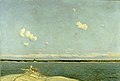
- Tom Thomson, The West Wind, 1917


European collection [edit]
- Tintoretto – Christ Washing His Disciples' Feet, c. 1545–1555
- Circle of Hans Holbein the Younger – Portrait of King Henry Viii, c. 1560s
- Peter Paul Rubens - Massacre of the Innocents, c. 1611–12
- Gian Lorenzo Bernini, Bosom of Pope Gregory XV, c. 1621
- Peter Paul Rubens – The Raising of the Cross, oil on paper version, c. 1638
-

-

Nicolas Poussin, Venus, Female parent of Aeneas, presenting him with Arms forged by Vulcan, c. 1636–37
-

-

-
-

-

-

Jean-Léon Gérôme, The Antique Pottery Painter: Sculpturæ vitam insufflat pictura, 1893
-

Paul Gauguin, Nave Nave Fenua from the Noa Noa Serial, 1893–94
-

Modern and contemporary collections [edit]



See also [edit]
- Civilization in Toronto
- List of art museums
- List of museums in Toronto
- Ontario Association of Fine art Galleries
Notes [edit]
- ^ In November 2017, a painting past Leonardo da Vinci, Salvator Mundi sold for US$450.one million, breaking the previous record set past the sale of Ruben'south Massacre of the Innocents in 2002 (United states$106 million, adapted for inflation in 2017).
- ^ The Art Gallery of Ontario renamed the painting to Church at Yuquot Village in 2018. The painting was originally titled The Indian Church.
- ^ This photo was taken when the sculpture was situated at the southwest corner of Dundas Street and McCaul Street. The sculpture was moved to Grange Park in 2017.
References [edit]
- ^ "Exhibition and museum visitor figures 2018". The Fine art Newspaper. 311: xv. April 2019.
- ^ AGO Leadership Squad
- ^ Ago Board of Trustees
- ^ a b "Fine art Gallery of Ontario Appoints Xiaoyu Weng as Carol and Morton Rapp, Curator, Modern & Contemporary Fine art". ago.ca. Fine art Gallery of Ontario. Retrieved September 4, 2021.
- ^ "Ontario Society of Artists". concordia.ca.
- ^ a b O'Rourke, Kate (1997). "Ontario Society of Artists: 125 years". Archivaria. 44: 181–182.
- ^ "AGO Year in Review - List of Outset Founders" (PDF). Ago. p. xiv. Archived from the original (PDF) on September four, 2018. Retrieved September 3, 2018.
- ^ Osbaldeston 2011, p. 185.
- ^ a b c d e f g h i j g Bradbeer, Janice (Jan 21, 2016). "Once Upon A City: Art finds a habitation on The Grange". OurWindsor.ca . Retrieved Oct 23, 2019.
- ^ Concluding Will and Testament of Harriet Goldwin Smith. Athenaeum of Ontario, estate file no. 22382-1909, microfilm MS584, Reel 1822. 1909.
- ^ "The Grange: Overview | Agone Art Gallery of Ontario". www.agone.internet . Retrieved August 29, 2018.
- ^ a b c d e f g "Heritage Property Research and Evaluation Study: The Grange and Grange Park" (PDF). Heritage Preservation Services. City of Toronto. March 2015. Retrieved October 23, 2019.
- ^ a b c d McKenzie, Karen; Pfaff, Larry (1980). "The Art Gallery of Ontario Sixty Years of Exhibitions, 1906-1966". RACAR: Revue d'fine art canadienne / Canadian Art Review. vii (ane–ii): 62. doi:10.7202/1076877ar.
- ^ a b c d e f Nakamura 2012, p. 423.
- ^ a b c d Stoffman, Judy (January 28, 2018). "'A human of elegance, grace and expert judgment'". The Globe and Postal service. The Woodbridge Visitor. Retrieved Feb 6, 2020.
- ^ Nakamura 2012, p. 421.
- ^ a b c d due east Marshall 2017, p. 83.
- ^ a b "Canadian Architect". Canadian Builder. 38 (9): 24. September 1993.
- ^ a b c Osbaldeston 2011, p. 190.
- ^ DePalma, Anthony (December 8, 1996). "No Stomach for Art". The New York Times.
- ^ a b Kennicott, Philip (November 30, 2008). "A Complex Legacy". The Washington Post . Retrieved February 2, 2009.
- ^ Hume, Christopher (Feb 22, 2009). "Art in his blood and steel in his bones". Toronto Star . Retrieved April 13, 2009.
- ^ "Kenneth Thomson – a "Great Canadian"". Art Matters blog. Fine art Gallery of Ontario. June 12, 2006. Retrieved September 21, 2015.
- ^ "Returning Nazi-looted art in Canada". world wide web.lootedart.com. Canadian Jewish News. Archived from the original on Dec 24, 2015. Retrieved May 22, 2021.
The Art Gallery of Ontario (Ago) has 46 paintings and sculptures with what curators call "a gap in provenance," pregnant the history of ownership, in this case betwixt 1933 and 1945, has disappeared. Across the country, in public galleries big and pocket-size, there are like mysteries. To date, iii Canadian galleries (the Art Gallery of Hamilton, the National Art Gallery in Ottawa and the Montreal Museum of Fine Arts) have returned looted Holocaust-era paintings to heirs.
- ^ "Spoliation Enquiry". Art Gallery of Ontario. Archived from the original on Oct 28, 2020. Retrieved May 22, 2021.
- ^ a b "Renaming of Emily Carr painting spurs debate virtually reconciliation in art". CBC News. Canadian Broadcasting Corporation. May 23, 2018. Retrieved October 3, 2019.
- ^ "'That Is a Word That Causes Pain': A Toronto Museum Takes 'Indian' Out of the Title of an Emily Carr Painting". Artnet News. Artnet Worldwide Corporation. May 23, 2018. Retrieved Oct 3, 2019.
- ^ "The kids are alright: Art Gallery of Ontario offers free access for visitors 25 and nether, and reduced yearly passes for all". www.theartnewspaper.com. May 9, 2019. Retrieved Oct 23, 2019.
- ^ "Looted Fine art Committee - CLAE News". www.lootedartcommission.com. Archived from the original on May 14, 2008. Retrieved May 22, 2021.
north eighteen November 2020 the Commission jointly with the Art Gallery of Ontario, Toronto, Canada (AGO) announced the restitution of Still Life with Flowers by Jan van Kessel the Elder to the heirs of Dagobert and Martha David. In March 2020, the Commission made the restitution merits on behalf of the family, providing compelling prove that the painting had formerly belonged to the family who had fled Federal republic of germany to Belgium in 1939 just to exist trapped at that place, forced to live in hiding under the German occupation and to sell their possessions in order to survive. Post-obit the painting's forced auction in Brussels, it was traded through Amsterdam and Berlin before it was acquired by the dealer Wildenstein & Co. in London, England. A Canadian purchased the painting from Wildenstein in the early 1950s and donated it to the Ago in 1995.
- ^ "Agone returns painting to family unit following claim by the Commission for Looted Fine art in Europe" (PDF). Archived (PDF) from the original on November 24, 2020.
- ^ "AGO returns painting to family post-obit merits by the Committee for Looted Fine art in Europe". Art Gallery of Ontario . Retrieved May 22, 2021.
- ^ "Transformation Ago: Project Factsheet". ago.ca. Art Gallery of Ontario. Retrieved March three, 2020.
- ^ "Heritage easement agreement". City of Toronto. 2018. Retrieved October 23, 2019.
- ^ a b c d e f g h Osbaldeston 2011, p. 188.
- ^ Carr, Angela (October 23, 2011). "Architecture of Fine art Galleries in Canada". The Canadian Encyclopedia. Historica Canada. Retrieved October 24, 2019.
- ^ a b c d e f g h Osbaldeston 2011, p. 189.
- ^ Marshall 2017, p. 86.
- ^ Frank Gehry (Dec 7, 2008). "The Art Gallery of Ontario". designboom.com. Retrieved October 12, 2012.
- ^ a b c Boake, Terri Meyer (2013). Agreement Steel Pattern: An Architectural Design Transmission. Walter de Greyter. pp. 208–210. ISBN978-iii-0346-1048-3.
- ^ a b c d e Art Gallery of Ontario: Renovation and Addition. Canadian Wood Council. 2009. p. 5.
- ^ a b Fine art Gallery of Ontario: Renovation and Addition. Canadian Wood Council. 2009. p. 8.
- ^ a b c d Fine art Gallery of Ontario: Renovation and Addition. Canadian Wood Quango. 2009. p. 6.
- ^ a b Art Gallery of Ontario: Renovation and Add-on. Canadian Wood Council. 2009. p. 7.
- ^ Bradshaw, James (November 14, 2008). "Finished Ago puts Gehry's fears to rest". The Globe and Mail . Retrieved September 21, 2015.
- ^ Hume, Christopher (November thirteen, 2008). "Revamped AGO a modest masterpiece". Toronto Star . Retrieved February 2, 2009.
- ^ Ouroussoff, Nicolai (Nov 14, 2008). "Gehry Puts a Very Dissimilar Signature on His Old Hometown's Museum". The New York Times. p. C1. Retrieved February 2, 2009.
- ^ Piacente, Maria; Lord, Barry (2014). Manual of Museum Exhibitions. Rowman & Littlefield. p. 137. ISBN978-0-7591-2271-0.
- ^ "New David Milne Centre - AGO Press Release". AGO.ca. April 3, 2012. Retrieved October ii, 2018.
- ^ "General Data Fact Sheet". Art Gallery of Ontario. September fourteen, 2012. Retrieved Oct 16, 2012.
- ^ "Art, engineering and archives unite at the AGO's new David Milne Heart" (Press release). Art Gallery of Ontario. Apr xiii, 2012. Retrieved October 16, 2012.
- ^ a b c d e f Adams, James (April 9, 2012). "Ago study middle to highlight David Milne". The Globe and Mail. The World and Mail Inc. Retrieved October 4, 2019.
- ^ "Come and knock on our (new) door". Ago Fine art Matters blog . Retrieved October ane, 2018.
- ^ https://canadianart.ca/agenda/the-j-s-mclean-centre-for-indigenous-and-canadian-art/
- ^ "AGO selects team to lead the design of its expansion projection". Canadian Builder. April 27, 2022. Retrieved April 29, 2022.
- ^ Bozikovic, Alex (April 27, 2022). "The Art Gallery of Ontario launches a major expansion with 'super-subtle' architecture". The Globe and Mail . Retrieved April 28, 2022.
- ^ Nakamura 2012, p. 422.
- ^ a b "The African Collection". ago.ca. Art Gallery of Ontario. Retrieved September 30, 2019.
- ^ Martin, Sandra (May 28, 2013). "Murray Frum, developer and art collector, dies at 81". The Globe and Mail. The Woodbridge Company. Retrieved Feb 6, 2020.
- ^ Keene, Bryan C. (2019). Toward a Global Eye Ages: Encountering the World through Illuminated Manuscripts. Getty Publications. p. 91. ISBN978-1-6060-6598-3.
- ^ a b c "The Ethnic Drove". agone.ca. Art Gallery of Ontario. Retrieved September 30, 2019.
- ^ a b c "The Thomson Collection". agone.ca. Art Gallery of Ontario. Retrieved October 1, 2019.
- ^ a b c "The Canadian Drove". ago.ca. Art Gallery of Ontario. Retrieved September 30, 2019.
- ^ Nakamura 2012, p. 430.
- ^ a b c d Nakamura 2012, p. 428.
- ^ a b c d Humeniuk, Gregory (2014). "Reframing Tom Thomson and the Grouping of Seven in the Thomson Collection at the Art Gallery of Ontario: From Principles to Practice/Recadrage des oeuvres de Tom Thomson et du Groupe des sept figurant dans la drove Thomson du Musée des beaux-arts de l'Ontario: des principes à la pratique". Journal of Canadian Fine art History. 35 (2): 141142.
- ^ a b c d Bresge, Adina (June 28, 2018). "Toronto gallery to unveil cantankerous-cultural Canadian and Ethnic art centre". The National Post . Retrieved September 30, 2019.
- ^ a b Dobrzynski, Judith H. (June 29, 2018). "Ethnic art comes first in Art Gallery of Ontario'south new Canadian galleries". The Art Newspaper . Retrieved October 6, 2019.
- ^ McMaster 2009, p. 216.
- ^ McMaster 2009, p. 220.
- ^ McMaster 2009, p. 217.
- ^ "AGO to sell up to xx A.Y. Jackson paintings to make room for underrepresented artists". CBC News. Canadian Broadcasting Corporation. January xiv, 2019. Retrieved October ix, 2019.
- ^ "Please exist seated". Fine art Gallery of Ontario . Retrieved May 23, 2020.
- ^ Nakamura 2012, p. 424.
- ^ "The J. Due south. McLean Centre for Indigenous and Canadian Art". Canadian Art. July 1, 2018. Retrieved August 29, 2018.
- ^ Nakamura 2012, p. 426.
- ^ a b c d "The Contemporary Collection". ago.ca. Art Gallery of Ontario. Retrieved September 30, 2019.
- ^ a b Mudhar, Raju (Apr four, 2019). "Ready for your selfie? Agone'due south permanent Kusama Infinity Mirrored Room now open". The Toronto Star. Torstar Corporation. Retrieved October 4, 2019.
- ^ a b c "The European Collection". agone.ca. Art Gallery of Ontario. Retrieved September xxx, 2019.
- ^ Alleyne, Allyssia (December 9, 2016). "500-year-erstwhile secrets of boxwood miniatures unlocked". CNN. Turner Broadcasting Systems, Inc. Retrieved October ane, 2016.
- ^ Brown, Ian (November 4, 2016). "Ago showroom raises profound questions nearly ancient handmade objects". The Globe and Mail service. The Globe and Postal service Inc. Retrieved October 1, 2019.
- ^ a b c d e f "'Too naked, also violent': The Art Gallery of Ontario'south troubling $100M masterpiece hits the route". The Toronto Star. Torstar Corporation. Baronial 10, 2018. Retrieved October 4, 2019.
- ^ Kinsella, Eilseen (Nov 15, 2017). "The Last Known Painting by Leonardo da Vinci Just Sold for $450.3 Meg". ARTnews. Fine art Media Holdings. Retrieved December 16, 2019.
- ^ a b Ditmars, Hadani (Baronial 23, 2019). "Art Gallery of Ontario acquires a Caillebotte after long legal struggle". The Art Newspaper. Umberto Allemandi & Co. Publishing Ltd. Retrieved October 26, 2019.
- ^ a b c "The Modern Collection". agone.ca. Art Gallery of Ontario. Retrieved September xxx, 2019.
- ^ DK Eyewitness Travel Guide Canada. Penguin. 2018. p. 182. ISBN978-one-4654-7778-i.
- ^ Marshall 2017, p. 82.
- ^ Marshall 2017, p. 81–82.
- ^ a b c "The Photography Collection". ago.ca. Art Gallery of Ontario. Retrieved September 30, 2019.
- ^ Dawson, Aimee (Dec xviii, 2017). "The acme ten museum acquisitions of 2017". The Art Newspaper.
- ^ a b c Reid, Tashauna (June 6, 2019). "AGO acquires large collection of historical Caribbean photographs". CBC News. Canadian Broadcasting Corporation. Retrieved October four, 2019.
- ^ a b "The Prints and Drawings Drove". agone.ca. Art Gallery of Ontario. Retrieved September 30, 2019.
- ^ Hustak, Brian (December 3, 2008). "Betty Goodwin was a giant in Canadian art". Vancouver Sun. Postmedia Network Inc. Retrieved October five, 2019.
- ^ "The dour merely compassionate art of Käthe Kollwitz". TVO Current Affairs. The Ontario Educational Communications Say-so. November 1, 2018. Retrieved October 23, 2019.
- ^ "The AGO's Edward P. Taylor Library & Athenaeum". Fine art Gallery of Ontario.
- ^ a b "Edward P. Taylor Library & Archives". Art Gallery of Ontario . Retrieved February 27, 2019.
- ^ "Other Libraries". ocadu.ca. OCAD University. 2019. Retrieved December 3, 2019.
- ^ "Horizon Data Portal". agone.internet.
- ^ "Edward P. Taylor Enquiry Library: Thomson Collection Resource Guide" (PDF). Art Gallery of Ontario. 2011.
- ^ "Library & Athenaeum Collection". Art Gallery of Ontario . Retrieved February 27, 2019.
- ^ a b c "Margaux Williamson is the Art Gallery of Ontario's current artist-in-residence". Toronto Star. March 22, 2012.
- ^ 25k Mocca Accolade honours arts patrons partners in fine art. CBC News.
- ^ a b AGO Launches Creative person-in-Residence Program with Winnipeg-born Artist Paul Butler | newz4u.cyberspace
- ^ Ontario, Art Gallery of. "Indian artist Gauri Gill wins $50,000 Grange Prize :: AIMIA | Agone Photography Prize". www.ago.internet . Retrieved March 7, 2016.
- ^ "Reason to Love Toronto: yoga classes at the Fine art Gallery of Ontario". Toronto Life. Archived from the original on April 7, 2014. Retrieved March five, 2014.
- ^ Sarah Lazarovic (November 12, 2011). "Why the Art Gallery of Ontario wants you to stretch among the sculptures". National Post.
- ^ Fine art Gallery of Ontario offers yoga Archived March 5, 2014, at the Wayback Automobile
- ^ Heaven Goodden, ARTINFO Canada. "AGO Announces New Artist-in-Residence, the Celebrated Hiraki Sawa". Artinfo.
- ^ a b c d e f g h i j thou fifty yard n o p q r s t u "Artist-in-Residence | AGO Art Gallery of Ontario". world wide web.ago.cyberspace . Retrieved March 11, 2017.
- ^ Lorinc, John (September 14, 2012). "A graffitist who works on the city'south dime". The Globe and Mail.
- ^ "Qatari Sheikh'southward Unpaid Sale Tab, Corcoran Seeks 'Visionary Leader', and More than". Artinfo.
- ^ "Artist-in-Residence". Art Gallery of Ontario. Retrieved July xviii, 2014.
- ^ Wright, Matthew. "Fine art Gallery of Ontario becomes the first Canadian museum to participate in the Google Fine art Project". National Post. National Post. Retrieved January xxx, 2016.
- ^ "Fine art Gallery of Ontario". Retrieved January 30, 2016.
Further reading [edit]
- Marshall, Christopher R. (2017). Sculpture and the Museum. Routledge. ISBN978-1-3515-4955-4.
- McMaster, Gerald (2009). "Art History Through the Lens of the Nowadays?". Journal of Museum Education. 34 (3): 215–222. doi:10.1080/10598650.2009.11510638. S2CID 194089306.
- Nakamura, Naohiro (2012). "The representation of First Nations art at the Fine art Gallery of Ontario". International Journal of Canadian Studies. 45–46 (45–46): 417–440. doi:10.7202/1009913ar.
- Osbaldeston, Marking (2011). Unbuilt Toronto ii: More of the City That Might Accept Been. Dundurn. ISBN978-1-4597-0093-2.
External links [edit]
- Official website

- Fine art Gallery of Ontario at Google Arts & Civilization
Source: https://en.wikipedia.org/wiki/Art_Gallery_of_Ontario
0 Response to "As a Director of a Small Art Gallery One of Dredericas Major Conerns"
Post a Comment